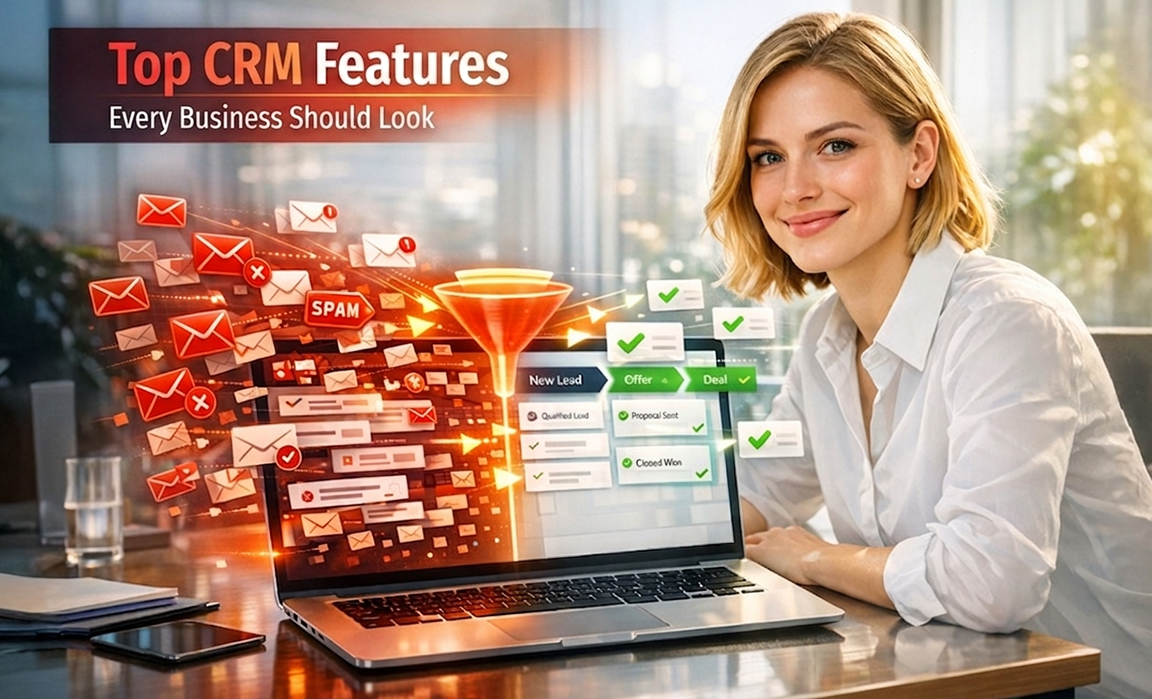
In today’s hyper-competitive digital landscape, customer relationships are no longer managed—they are engineered, optimized, and continuously enhanced. As we step into 2026, Customer Relationship Management (CRM) systems have evolved far beyond simple contact databases. Modern CRM platforms are now intelligent ecosystems powered by artificial intelligence, automation, and deep data insights.
For businesses aiming to stay ahead, choosing the right CRM is not optional—it is a strategic necessity. However, with countless options available, identifying the most valuable features can be overwhelming. This guide explores the top CRM features every business should look for in 2026, helping you make an informed and future-proof decision.
1. AI-Powered Automation
Artificial intelligence has become the backbone of modern CRM systems. In 2026, businesses should prioritize CRM platforms that integrate advanced AI capabilities.
Why It Matters
AI-powered automation reduces manual work, enhances decision-making, and improves customer engagement. It allows teams to focus on strategic tasks rather than repetitive processes.
Key Capabilities
- Predictive lead scoring
- Automated email responses
- Intelligent workflow automation
- Sales forecasting using machine learning
AI can analyze customer behavior patterns and recommend next-best actions, significantly increasing conversion rates and customer satisfaction.
2. Omnichannel Communication Integration
Customers now interact with businesses across multiple platforms—email, social media, live chat, messaging apps, and more. A CRM system must unify these channels into a single interface.
Benefits
- Consistent customer experience
- Centralized communication history
- Faster response times
What to Look For
- Integration with messaging platforms (WhatsApp, SMS, chatbots)
- Social media tracking and engagement tools
- Unified inbox for all communications
An omnichannel CRM ensures no customer interaction is lost, creating a seamless and personalized experience.
3. Advanced Data Analytics and Reporting
Data is the new currency, and CRM systems are the vault. In 2026, advanced analytics is a must-have feature.
Key Features
- Real-time dashboards
- Customizable reports
- Predictive analytics
- Customer behavior insights
Impact
Businesses can make data-driven decisions faster, identify trends, and optimize marketing and sales strategies. Predictive analytics can even anticipate customer churn before it happens.
4. Personalization at Scale
Modern customers expect personalized experiences. CRM systems must enable businesses to deliver tailored interactions at scale.
Features to Prioritize
- Dynamic customer segmentation
- Personalized email campaigns
- Behavioral tracking
- AI-driven recommendations
Why It’s Critical
Personalization increases engagement, boosts conversions, and strengthens customer loyalty. A CRM that lacks this capability risks falling behind competitors.
5. Mobile-First Accessibility
With remote work and on-the-go business operations becoming the norm, mobile CRM functionality is essential.
Must-Have Mobile Features
- Full-featured mobile apps
- Offline access
- Real-time notifications
- Voice-to-text data entry
Business Advantage
Sales teams can update data, access customer information, and close deals from anywhere, increasing productivity and responsiveness.
6. Seamless Integration with Other Tools
A CRM system should not operate in isolation. Integration with other business tools is crucial for efficiency.
Common Integrations
- Marketing automation platforms
- Accounting software
- E-commerce platforms
- Project management tools
What to Check
- Availability of APIs
- Native integrations
- Ease of third-party connections
Seamless integration eliminates data silos and ensures smooth workflows across departments.
7. Robust Data Security and Compliance
With increasing concerns about data privacy, security is a top priority in 2026.
Essential Security Features
- End-to-end encryption
- Role-based access control
- Multi-factor authentication
- Compliance with global regulations (GDPR, etc.)
Why It Matters
A data breach can damage reputation and lead to significant financial losses. A secure CRM protects both your business and your customers.
8. Customization and Flexibility
Every business has unique needs. A one-size-fits-all CRM rarely delivers optimal results.
Key Customization Options
- Custom fields and workflows
- Dashboard personalization
- Industry-specific modules
Benefit
A flexible CRM adapts to your processes rather than forcing you to change your operations.
9. Customer Journey Mapping
Understanding the customer journey is essential for delivering meaningful experiences.
Features to Look For
- Visual journey mapping tools
- Touchpoint tracking
- Lifecycle stage management
Impact
Businesses can identify pain points, optimize interactions, and create more effective engagement strategies.
10. Sales Pipeline Management
A strong CRM must provide clear visibility into the sales process.
Core Features
- Drag-and-drop pipeline views
- Deal tracking
- Automated reminders
- Performance analytics
Why It’s Important
Sales teams can manage opportunities efficiently, identify bottlenecks, and close deals faster.
11. Marketing Automation Capabilities
Marketing and CRM are no longer separate functions—they are deeply interconnected.
Must-Have Features
- Email marketing automation
- Lead nurturing workflows
- Campaign tracking
- A/B testing tools
Business Value
Automation ensures consistent communication and helps convert leads into loyal customers.
12. Customer Support and Helpdesk Integration
Customer service plays a crucial role in retention. A CRM should include or integrate with support tools.
Features to Consider
- Ticketing systems
- Live chat support
- Knowledge base integration
- SLA tracking
Benefit
Improved customer satisfaction and faster issue resolution.
13. Voice and Conversational CRM
Voice technology and conversational interfaces are becoming increasingly popular.
Key Features
- Voice commands for data entry
- AI chatbots
- Natural language processing
Why It’s Trending
These features make CRM systems more intuitive and accessible, reducing the learning curve.
14. Real-Time Collaboration Tools
Teams need to work together efficiently, especially in remote or hybrid environments.
Collaboration Features
- Shared dashboards
- Internal messaging
- Task assignments
- Document sharing
Result
Improved team coordination and faster decision-making.
15. Scalability for Future Growth
Your CRM should grow with your business.
What to Look For
- Flexible pricing plans
- Modular features
- Cloud-based infrastructure
Long-Term Benefit
Avoid the need to switch systems as your business expands.
16. Low-Code or No-Code Functionality
Businesses want flexibility without relying heavily on developers.
Features
- Drag-and-drop workflow builders
- Visual automation tools
- Custom app creation
Advantage
Teams can adapt the CRM quickly without technical expertise.
17. Customer Data Platform (CDP) Capabilities
CRM systems are evolving into comprehensive customer data platforms.
Key Elements
- Unified customer profiles
- Data from multiple sources
- Real-time updates
Impact
Provides a 360-degree view of customers, enabling better decision-making.
18. Predictive Customer Insights
Beyond analyzing past data, modern CRMs predict future behavior.
Capabilities
- Churn prediction
- Purchase forecasting
- Customer lifetime value estimation
Benefit
Proactive strategies can be implemented to retain customers and increase revenue.
19. Workflow Automation and Task Management
Efficiency is key in 2026. Workflow automation ensures smooth operations.
Features
- Task automation
- Approval workflows
- Event-triggered actions
Outcome
Reduced manual work and improved operational efficiency.
20. User-Friendly Interface and UX Design
Even the most powerful CRM is useless if it’s difficult to use.
What to Prioritize
- Intuitive navigation
- Clean dashboard design
- Minimal learning curve
Why It Matters
Higher user adoption leads to better data quality and overall effectiveness.
Conclusion
As businesses navigate the complexities of 2026, choosing the right CRM system is more critical than ever. The ideal CRM is not just a tool—it is a strategic partner that drives growth, enhances customer relationships, and improves operational efficiency.
From AI-powered automation to predictive analytics and omnichannel integration, the features outlined in this article represent the future of CRM technology. Businesses that invest in these capabilities will be better positioned to adapt, compete, and thrive in an ever-evolving marketplace.
When evaluating CRM options, focus on scalability, flexibility, and user experience. A well-chosen CRM system will not only meet your current needs but also support your long-term vision.
Ultimately, the best CRM is one that empowers your team, delights your customers, and transforms data into actionable insights. Make the right choice today, and you’ll set your business up for success tomorrow.