In today’s digital economy, website availability is directly connected to business success. Whether you operate an eCommerce store, SaaS platform, financial service, online learning portal, or enterprise application, maintaining uninterrupted online access is critical.
One of the biggest threats facing modern businesses is Distributed Denial of Service (DDoS) attacks. These attacks can overwhelm servers with massive volumes of traffic, causing websites and applications to become unavailable. Downtime often results in lost revenue, damaged customer trust, and reduced search engine rankings.
This is why organizations increasingly seek a cloud hosting provider with DDoS protection. Modern cloud infrastructure combines scalability, flexibility, and advanced cybersecurity features to ensure businesses remain online even during sophisticated cyberattacks.
In this comprehensive guide, you’ll learn how DDoS protection works, why cloud hosting is the ideal environment for security, and how to choose the right hosting provider for long-term success.
Understanding Cloud Hosting
Cloud hosting is a hosting model where websites and applications run on interconnected virtual servers rather than a single physical machine.
Traditional hosting environments often rely on a single server. If that server experiences hardware failure or excessive traffic, performance suffers or the website becomes unavailable.
Cloud hosting distributes resources across multiple servers, delivering:
- Higher uptime
- Better scalability
- Improved performance
- Resource flexibility
- Enhanced security
- Disaster recovery capabilities
Businesses can instantly allocate additional computing resources when traffic spikes occur, making cloud hosting particularly valuable for growing organizations.
What Is a DDoS Attack?
A Distributed Denial of Service (DDoS) attack occurs when attackers flood a target server with enormous amounts of traffic.
The objective is simple:
- Exhaust server resources
- Slow down applications
- Cause service outages
- Disrupt business operations
Attackers often use large networks of compromised devices known as botnets to generate malicious traffic.
Common targets include:
- E-commerce stores
- Financial institutions
- Government agencies
- Gaming platforms
- SaaS providers
- Media websites
Even small businesses can become victims because automated attack tools are widely available.
Types of DDoS Attacks
1. Volumetric Attacks
These attacks aim to consume network bandwidth.
Examples include:
- UDP floods
- ICMP floods
- DNS amplification attacks
Volumetric attacks can generate traffic measured in terabits per second.
2. Protocol Attacks
Protocol attacks target server resources and networking infrastructure.
Examples include:
- SYN floods
- Ping of Death
- Fragmentation attacks
These attacks exploit weaknesses in communication protocols.
3. Application Layer Attacks
Application attacks focus on web applications rather than network infrastructure.
Examples include:
- HTTP floods
- API abuse
- Login page attacks
These attacks are often difficult to detect because they resemble legitimate user traffic.
Why Businesses Need DDoS Protection
The consequences of a successful DDoS attack can be severe.
Revenue Loss
Every minute of downtime can translate into lost sales and reduced profitability.
Brand Damage
Customers expect online services to remain available. Repeated outages can damage trust and reputation.
Reduced Search Rankings
Search engines prioritize reliable websites. Frequent downtime may negatively affect SEO performance.
Increased Recovery Costs
Organizations often spend significant resources recovering from cyberattacks.
Customer Churn
Users who experience disruptions may switch to competitors offering more reliable services.

How Cloud Hosting Providers Deliver DDoS Protection
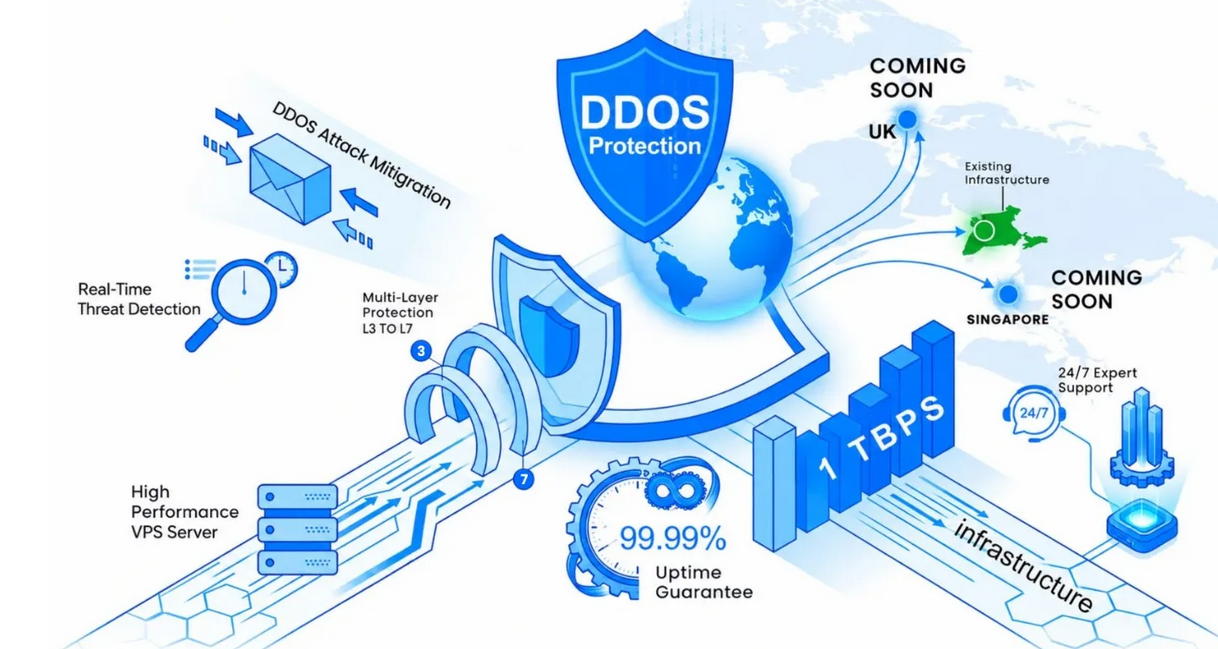
A professional cloud hosting provider uses multiple security layers to identify and mitigate attacks.
Traffic Monitoring
Advanced systems continuously monitor incoming traffic patterns.
Abnormal activity is detected in real time, allowing mitigation systems to activate immediately.
Traffic Filtering
Malicious requests are identified and blocked before reaching the origin server.
Legitimate users continue accessing services without interruption.
Global Network Distribution
Cloud providers operate worldwide infrastructure capable of absorbing enormous traffic volumes.
Instead of overwhelming a single server, attack traffic is distributed across multiple locations.
Rate Limiting
Providers limit excessive requests from suspicious sources.
This prevents automated systems from exhausting resources.
Web Application Firewalls (WAF)
A Web Application Firewall filters malicious traffic at the application level.
WAF solutions can block:
- SQL injection attempts
- Cross-site scripting attacks
- Bot traffic
- Application-layer DDoS attacks
Key Benefits of Choosing a Cloud Hosting Provider with DDoS Protection
Maximum Uptime
Business continuity depends on website availability.
Built-in DDoS mitigation significantly reduces downtime risks.
Enhanced Security
Modern cloud hosting environments offer:
- Firewalls
- Intrusion detection systems
- Malware scanning
- Security monitoring
- DDoS mitigation
Scalability
Traffic spikes can occur due to:
- Marketing campaigns
- Viral content
- Product launches
- Seasonal demand
Cloud hosting automatically scales resources when needed.
Cost Efficiency
Instead of investing in expensive on-premises infrastructure, businesses pay only for resources they use.
Better Customer Experience
Fast-loading and consistently available websites improve customer satisfaction and retention.
Industries That Benefit Most from DDoS-Protected Cloud Hosting
E-Commerce
Online stores rely on continuous availability.
Even a short outage can lead to substantial revenue loss.
SaaS Companies
Software providers must maintain uninterrupted service to meet customer expectations and contractual obligations.
Financial Services
Banks, fintech companies, and payment processors face constant cyber threats and require robust protection.
Healthcare
Healthcare organizations must protect patient portals and digital services from disruptions.
Education
Universities and online learning platforms experience traffic spikes and increasingly face cyberattacks.
Media and Streaming
High-traffic content websites require scalable infrastructure capable of handling large audiences.
Features to Look for in a Cloud Hosting Provider with DDoS Protection
When evaluating hosting providers, consider the following features.
Real-Time Attack Detection
Immediate detection reduces attack impact and speeds response times.
Automated Mitigation
Automated systems can neutralize attacks within seconds.
Global Content Delivery Network (CDN)
CDNs distribute content across multiple regions.
Benefits include:
- Faster loading speeds
- Reduced latency
- Enhanced DDoS resilience
SSL Certificates
Encryption protects data transmitted between users and servers.
Backup and Disaster Recovery
Reliable backups ensure rapid recovery after security incidents.
24/7 Security Monitoring
Round-the-clock monitoring enables providers to respond quickly to emerging threats.
High Availability Architecture
Redundant infrastructure prevents single points of failure.

The Role of Artificial Intelligence in DDoS Protection
Modern security platforms increasingly rely on artificial intelligence and machine learning.
AI-powered systems can:
- Analyze traffic behavior
- Detect anomalies
- Identify attack patterns
- Block malicious requests
- Reduce false positives
As cyber threats evolve, AI-driven protection becomes increasingly important.
Cloud Hosting vs Traditional Hosting for Security
Traditional Hosting
Advantages:
- Lower initial cost
- Simpler deployment
Limitations:
- Limited scalability
- Single points of failure
- Reduced attack resistance
Cloud Hosting
Advantages:
- Distributed infrastructure
- Automatic scaling
- Better redundancy
- Advanced security
- Integrated DDoS protection
For businesses prioritizing uptime and security, cloud hosting generally provides superior protection.

SEO Benefits of Reliable Cloud Hosting
Search engines evaluate website performance and availability.
Benefits include:
- Faster page loading
- Improved Core Web Vitals
- Lower bounce rates
- Better user engagement
- Increased crawl efficiency
Reliable hosting contributes to stronger organic search performance over time.
Conclusion
Choosing a cloud hosting provider with DDoS protection is no longer optional for businesses that depend on online operations. Cyberattacks continue to increase in frequency and sophistication, making robust infrastructure essential for maintaining uptime, protecting customer trust, and supporting long-term growth.
By selecting a hosting solution that combines scalable cloud resources, advanced traffic filtering, real-time threat detection, global network distribution, and automated mitigation systems, organizations can significantly reduce cybersecurity risks while improving performance and reliability.
As digital transformation accelerates across industries, businesses that invest in secure cloud hosting gain a competitive advantage through enhanced availability, stronger customer confidence, and better operational resilience.